[Generation Goal] Generate a relentless 30-second desert duel between exactly two warriors in one uninterrupted continuous take. The Sandstorm Nomad Duelist and the Black-Iron Storm Raider fight through a violent sandstorm using fast, forceful, physically grounded blade combat. Every major exchange must clearly show anticipation, acceleration, visible weapon contact, recoil, complete follow-through, and immediate recovery. The Sandstorm Nomad Duelist ultimately wins by breaking the Raider's obsidian blade during the final overwhelming clash. No blood or visible bodily injury occurs. The Raider's defeat is communicated only through the destruction of the weapon, physical recoil, retreat, and disappearance into the sandstorm. The entire sequence is ONE CONTINUOUS TAKE with no cuts. [Reference Material Roles] @[image_1 defines the Sandstorm Nomad Duelist: lean desert-warrior proportions, wind-torn ochre/orange layered cloth, wrapped face and neck, conical hat, wrapped arms and lower legs, dark waist belt, worn footwear, and two curved steel blades. Preserve the character's silhouette, clothing construction, proportions, colors, weapons, and distinctive features throughout. Do not use the reference image's white background, static character-sheet pose, framing, or lighting. @[image_2 defines the Black-Iron Storm Raider: imposing armored proportions, deeply shadowed hood and masked face, layered worn black and charcoal armor, ragged cloak and shoulder coverings, armored gauntlets and legs, dark materials, and oversized jagged obsidian blade. Preserve the character's silhouette, armor construction, proportions, colors, weapon, and distinctive features throughout. Do not use the reference image's white background, static character-sheet pose, framing, or lighting. Do not interchange either character's clothing, weapons, proportions, silhouettes, colors, or materials. [Subject and Weapon Continuity] Exactly two characters exist throughout the sequence. The Sandstorm Nomad Duelist remains the orange/ochre warrior and uses the same two curved steel blades throughout. The Black-Iron Storm Raider remains the black/charcoal armored warrior and uses the same single oversized jagged obsidian blade until that blade is destroyed during the final clash. No additional fighters, weapons, creatures, or background characters appear. Both characters remain anatomically consistent and physically dimensional throughout all camera movement and combat. [Visual Style Lock] 2.5D graphic painterly AAA game concept art in motion, with bold silhouettes, chunky geometric shape language, simplified planar shading, rough visible brush strokes, coarse dry-brush texture, strong light-and-shadow separation, and slightly unfinished painted contours. Preserve full sculptural body volume, convincing physical weight, dimensional anatomy, strong foreshortening, real spatial overlap, grounded foot contact, deep foreground-to-background parallax, and dynamic three-dimensional camera movement. The 2.5D appearance comes entirely from the graphic hand-painted rendering rather than flattened geometry. Use three to five large value groups per subject, broad angular shadow planes, limited gradients, matte painted surfaces, visible bristle marks, broken dry-brush grain, rough pigment-like edges, and simplified but strongly dimensional forms. Sand, airborne grit, sparks, cloth motion, dust clouds, and weapon fragments share the same painterly treatment: chunky graphic shapes, directional brush marks, rough particulate edges, and controlled value grouping rather than photorealistic particles. Every frame should resemble premium animated AAA game concept art brought into motion. Not paper-cutout animation. Not flat collage. Not bas-relief. Not anime cel shading. Not photorealistic live action. Not photorealistic CGI. Not glossy PBR rendering. Not a game-engine render. [Environment] A vast windswept desert battlefield consumed by an approaching sandstorm. Uneven dunes and hard-packed sand create readable terrain beneath the fighters. A towering storm wall fills the background while turbulent dust fronts move laterally across the battlefield. Maintain strong three-layer spatial depth throughout: Foreground: fast-moving painted grit, sand ribbons, dust sheets, and occasional debris passing extremely close to the lens. Midground: the two fighters and their combat. Background: layered dunes disappearing into the enormous storm wall. Sand reacts physically to every movement. Sprinting feet carve into the surface, sudden pivots throw directional sprays, near-miss blades tear narrow trenches through loose sand, and heavy impacts create dense low dust bursts. [Color and Lighting] Use a tightly controlled graphic desert palette. The Sandstorm Nomad Duelist is the dominant warm accent: saturated burnt orange, ochre, rust, dark brown, and muted cloth shadows. The Black-Iron Storm Raider remains charcoal black, graphite gray, dark slate, and restrained cold steel. The desert uses pale sand, desaturated ochre, dusty beige, muted burnt-orange haze, and deep storm-shadow gray. A low harsh desert sun burns through the storm from behind, producing large graphic backlit shapes rather than photorealistic lens effects. Use a strong warm painted rim along the Nomad Duelist's silhouette and restrained cold slate-blue shadow separation across the Black-Iron Raider. As the duel approaches its climax, the storm haze becomes increasingly burnt orange while the Raider remains a dark graphic silhouette against it. No glossy surfaces and no photorealistic anamorphic lens flare. Bright sun interaction appears as broad painterly bloom, rough-edged atmospheric glare, and controlled graphic light shapes. [Combat Performance] Both fighters move with physical weight and aggressive intent. The Sandstorm Nomad Duelist fights with low, agile footwork, sharp direction changes, compact evasions, fast paired-blade combinations, and explosive counterattacks. The Black-Iron Storm Raider fights with heavier momentum, wider committed strikes, powerful forward pressure, and the visible inertia of the oversized obsidian weapon. Avoid decorative choreography. Every parry has visible blade contact and physical resistance. Arms, shoulders, hips, cloth, armor, sand, and weapons react naturally to changes in momentum. Neither fighter freezes while waiting for the next choreography beat. [Camera] ONE CONTINUOUS TAKE. No cuts. Use an aggressive close chase-camera that continuously moves around and between the two fighters while preserving readable combat geography. The camera never escapes upward into a distant aerial view and never retreats far enough to weaken the physical intensity. Use fast motivated orbital movement during exchanges, controlled whip-pans following sudden direction changes, strong foreground sand parallax, and snap focus transitions between nearby debris and the fighters. For extreme close blade moments, the same continuous camera physically dives close to the weapon interaction and then moves naturally back into the surrounding fight. These are not insert cuts. Avoid random camera spinning, weightless drone movement, constant shaking, or camera motion that conceals weapon contact. [Event Script] Opening: The camera punches directly through a dense painterly wall of wind-driven sand and emerges low beside the Sandstorm Nomad Duelist. The Duelist stands planted against the storm with both curved steel blades already drawn. Orange and ochre cloth lashes violently downwind while loose sand streams around the feet. At approximately the three-second mark, the storm wall behind the battlefield visibly bulges outward. The Black-Iron Storm Raider suddenly bursts through the moving dust with the oversized obsidian blade already committed to a powerful descending attack. The Duelist reacts immediately. Steel meets obsidian with a violent physical parry. The weapons visibly compress against one another for an instant before separating. A directional burst of painterly sparks and coarse dust explodes from the exact contact point while both fighters absorb the recoil through their arms, shoulders, and planted feet. The camera whip-orbits around the collision while remaining close to the fighters. Around the six-second mark, without cutting, the camera dives extremely close beside the grinding weapon edges. For a brief moment the blade contact dominates the foreground: rough matte steel against cracked black obsidian, vibrating under pressure while streaks of painted grit and sparks rush past the lens. The camera then physically swings back out into a wider close orbit as the fighters disengage. Around the ten-second mark, a dense dust devil sweeps directly between the camera and both fighters. Focus catches the foreground spiral of sand first, then snaps through the moving veil toward the combat continuing behind it. The dust becomes natural foreground occlusion rather than a transition or hidden cut. Around the thirteen-second mark, the Raider aggressively presses forward with a three-strike combination. First heavy strike. The Duelist steps back and catches it with crossed steel. Second strike changes direction immediately. The Duelist pivots and redirects it past the torso. The Raider rotates the shoulders into a third overwhelming attack. The Duelist barely clears the weapon path. Every near miss tears through the sand and throws broad painterly sprays in the direction of blade travel. The Duelist gives ground only under the Raider's immediate physical pressure and never becomes passive. Around the sixteen-second mark, the Raider's enormous obsidian blade passes extremely close to the camera as the Duelist drops beneath it. The same continuous camera follows the blade into an extreme close perspective. Time decelerates into the first controlled slow-motion beat. The camera curves around the crouched Duelist and passing Raider in a tight bullet-time-style orbit while preserving their real three-dimensional volume. Suspended sand grains become coarse painterly flecks and directional dry-brush marks. Torn orange cloth stretches through the wind while the Raider's dark cloak follows its heavier inertia. Around the eighteen-second mark, motion violently snaps back to real-time speed. The Duelist explodes upward from the crouch. Using the momentum of the recovery, the Duelist rotates through a decisive counterattack with the twin curved blades while the camera accelerates with the movement. The Raider recovers and brings the obsidian weapon around for one final committed clash. Around the twenty-two-second mark, both fighters drive toward each other. The Raider swings the massive obsidian blade with full-body force. The Duelist commits to the counterattack. One curved steel blade meets the obsidian weapon at a clear readable angle. The impact becomes the unquestionable climax of the duel. The steel blade drives through the weakened obsidian weapon. Time decelerates into the second and final slow-motion beat. The obsidian blade fractures from the exact contact point and breaks apart into large and small physically weighted fragments. The fragments remain graphic and painterly rather than photorealistic glass: angular charcoal-black pieces with rough painted contours, restrained highlights, and visible directional dry-brush texture. Fragments rotate according to the momentum of the collision and travel outward with believable weight and decreasing velocity. The orange storm backlight passes between the suspended fragments, creating bold graphic silhouettes and painted atmospheric glow. Around the twenty-five-second mark, everything snaps back into real-time speed. The fragments hit the sand around the fighters. The Raider recoils violently from the destroyed weapon, staggers backward several heavy steps, and loses the ability to continue the attack. The Duelist remains planted with both curved blades intact. The Raider retreats backward into the churning storm wall. Layers of wind-driven sand progressively obscure the black silhouette until the Raider completely disappears into the storm. The camera does not follow the Raider. Instead it transitions naturally into a controlled forward push toward the victorious Duelist. The Duelist remains alone in the battlefield while turbulent sand begins to settle. Orange cloth continues moving in the wind half a beat after the body becomes still. End on a powerful low hero angle with the Duelist filling the midground, both curved steel blades lowered but still held, while the enormous painterly storm wall moves behind the silhouette. The low sun burns through thinning dust as a broad rough-edged painted glow rather than a photographic lens flare. Hold this final composition through the end of the sequence without cutting. [Physics and Effects] Every physical interaction has readable direction, momentum, inertia, recoil, and environmental response. Sand parts violently beneath sprinting feet and blade impacts. Cloth follows acceleration and wind drag with delayed secondary motion. The Raider's heavier cloak and armor respond with greater inertia than the Duelist's lighter fabric. Sparks emerge only from actual weapon contact and travel along the physical direction of impact before falling and fading. The obsidian blade breaks only during the final decisive collision. Its fragments have believable mass, rotation, trajectory, gravity, ground contact, and falloff. Keep both fighters firmly grounded through contact shadows and displaced sand beneath every footfall. Effects remain integrated into the same rough painterly 2.5D concept-art rendering rather than becoming photorealistic particle simulations. [Audio] NO MUSIC. Use only tactile environmental and combat sound: Roaring desert wind and shifting sand. Heavy footfalls compressing loose terrain. Orange cloth snapping sharply in the storm. Heavier ragged cloak and armor movement from the Raider. Dry steel and obsidian impacts. Sharp ringing steel at every direct clash. Directional sand bursts during near misses. A deep compressed-air whoosh beneath each speed transition. A brief muffled vacuum-like drop during both slow-motion beats. A violent sonic snap when each sequence returns to full speed. A single sharp cracking impact when the obsidian weapon breaks. Weighted fragments striking and sinking into the sand. The Raider's heavy retreat gradually disappearing beneath the storm noise. After the Raider disappears, reduce the soundscape naturally until only the powerful desert wind and moving cloth remain. [Maintain Consistency] Maintain exactly two fighters throughout. Maintain the Sandstorm Nomad Duelist's identity, lean proportions, conical hat, wrapped face, orange/ochre layered clothing, cloth construction, and same two curved steel blades from @image_1. Maintain the Black-Iron Storm Raider's identity, imposing proportions, shadowed hood and mask, layered black armor, ragged cloak, and same oversized obsidian blade from @image_2 until that blade breaks during the climax. Do not interchange their costumes, weapons, colors, silhouettes, proportions, or movement styles. Maintain one uninterrupted continuous camera take with zero cuts. Only the two explicitly described slow-motion beats deviate from real-time motion. Maintain full sculptural body volume, real spatial overlap, strong foreshortening, grounded physical weight, foreground-to-background parallax, graphic planar shading, matte painterly materials, visible brushwork, dry-brush texture, and rough painted contours. No blood, gore, dismemberment, or depicted bodily injury. The Raider is defeated only through the shattered weapon, physical recoil, retreat, and disappearance into the storm. The Sandstorm Nomad Duelist is the unquestionable winner. No additional enemy or character appears. No photorealism, no glossy PBR, no game-engine rendering, no paper-cutout appearance, no flat collage, and no anime cel shading.

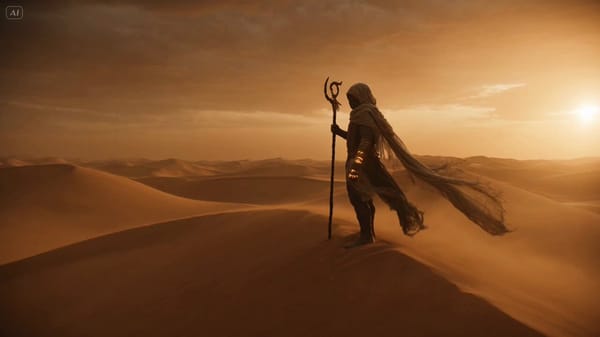
![[00:00-00:01] Cloaked desert warrior stands back to camera on a cracked dune ridge, tattered sa…](https://prompts.pixloop.ai/cdn-cgi/image/width=600,format=auto,quality=80/prompts/assets/prompts/2047764708753629502/0.jpg)