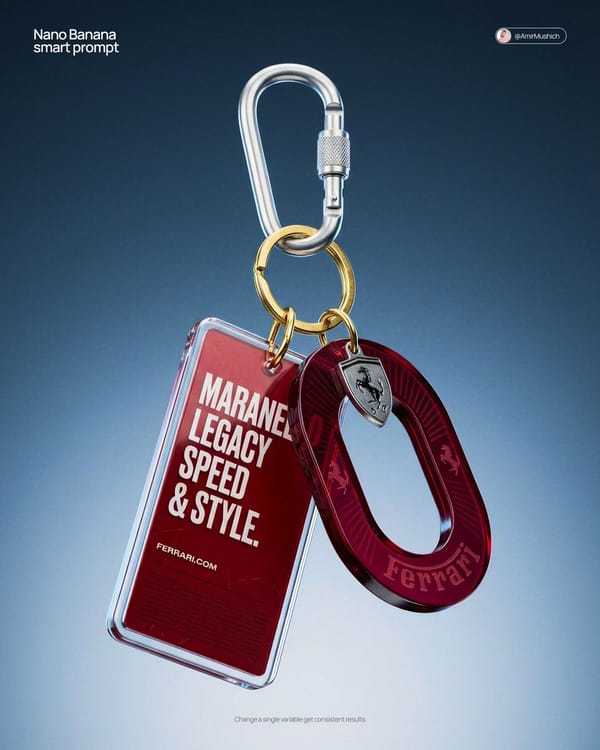
[BRAND NAME]
Act as a CGI Art Director and Environment Photographer creating a cinematic hero landscape with a glass logo sculpture emerging from a volcanic rock formation. References: editorial CGI landscape photography, crystal and glass object photography, volcanic terrain macro photography, dramatic sunset landscape cinematography.
PHASE 0: BRAND LOGO INTELLIGENCE
Retrieve the 100% canonical trademark-accurate primary mark of [BRAND NAME] from training data. Identify the single most iconic reduced form — symbol, monogram, or wordmark. Fidelity test: a brand designer must recognize this as the correct mark. The glass treatment is applied ON TOP of the correct logo geometry — transformation happens after accurate reconstruction, never instead of it. CRITICAL — NO ADDED CONTAINERS: do not add any enclosing shape, circle, oval, badge, or housing around the logo unless that container is part of [BRAND NAME]'s official canonical logo. The glass object is the logo form itself and nothing else.
PHASE 1: GLASS LOGO OBJECT — CRITICAL
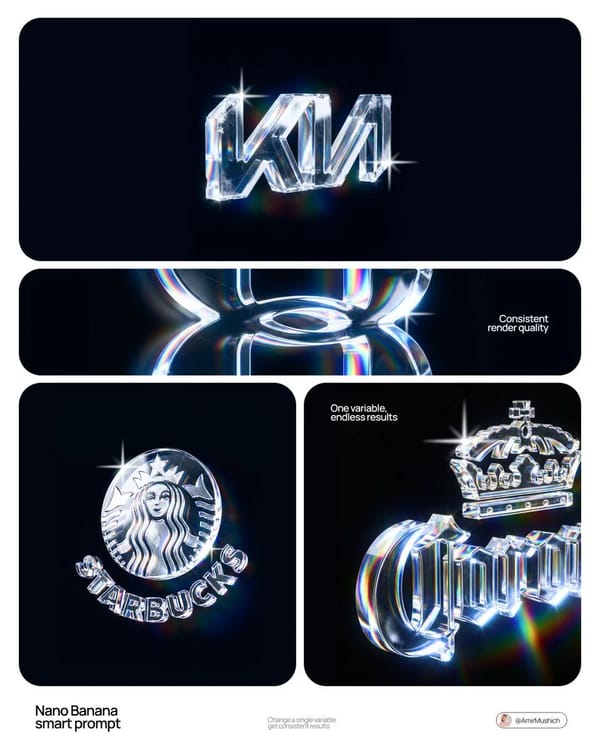
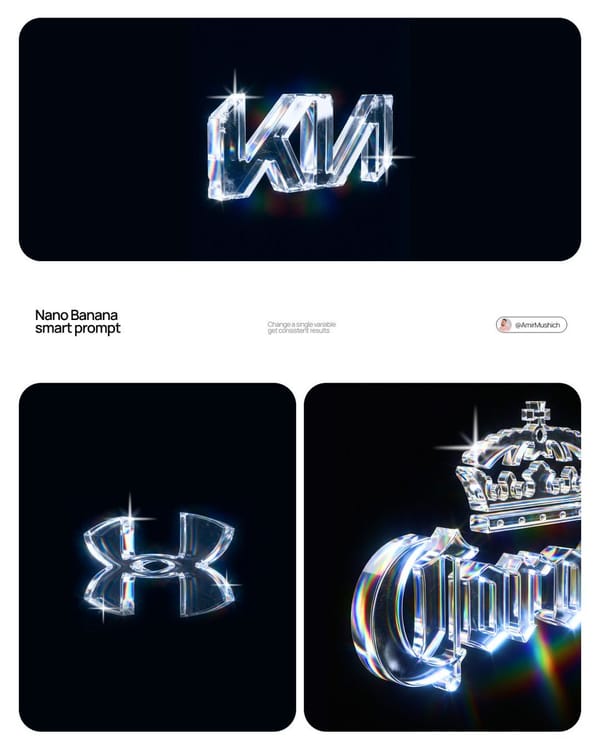
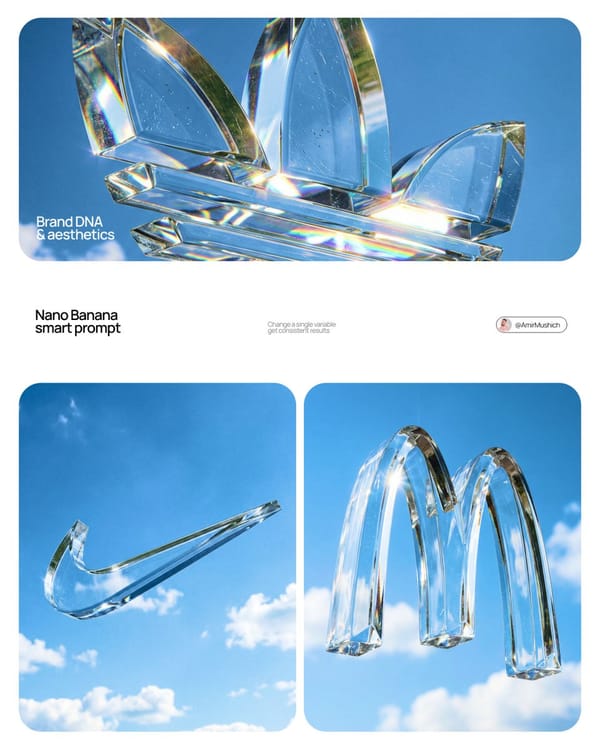
The canonical logo mark of [BRAND NAME] rendered as a solid three-dimensional optical glass sculpture — thick, physical, monumental. The glass object has the exact silhouette of the [BRAND NAME] logo. Object depth: 25 to 40% of the logo's total height — substantial physical thickness. All faces polished to sub-micron smoothness. Edges sharp and precise. Bottom cut at a slight bevel — allows the sculpture to stand embedded in rocks below. The glass object is slightly tilted backward 5 to 8° — monolithic standing-stone quality.
SCENE-INTEGRATED GLASS MATERIAL — CRITICAL: the glass is not a neutral colorless object dropped into the scene. It is a physically accurate optical material that absorbs, refracts, and reflects the scene's ambient color environment. The glass must feel like it belongs to this specific scene — tinted, influenced, and saturated by the red-orange atmospheric environment surrounding it.
Ambient color absorption: the glass material picks up the dominant scene colors — deep red-crimson from the background gradient and warm orange from the back light. The glass has a very subtle warm red-orange volume tint #3A0A00 at 8 to 12% opacity throughout its body. Transmission color: light passing through the glass carries the scene's warm orange-red quality — not neutral white, but slightly warm orange-tinted light consistent with the back light color. IOR: 1.5 to 1.7. Reflection color: reflections on glass surfaces carry the red gradient of the background and warm orange of the back light — front face upper zone reflects cool dark red from sky, lower zone reflects warm orange from back light. Edge glow: sharp edges emit intense orange-white luminous lines from back light entering through beveled base and traveling through the glass via total internal reflection — edge glow color is warm orange #FF8C00 matching primary back light. Internal caustics: orange back light creates warm caustic patterns inside the glass volume — visible as amber and orange light bands within the glass body. The overall glass appearance: a warm amber-tinted luminous crystal that feels native to the volcanic red landscape.
PHASE 2: VOLCANIC ROCK GROUND
The glass logo stands on and is partially embedded in a formation of volcanic basalt rocks. Rock properties: irregular dark grey to near-black basalt — #1A1A1A to #2D2D2D. Surface texture: rough, fractured, vesicular — gas bubble voids visible, sharp broken edges, fine crystalline grain. Rock sizes: large anchor rocks 15 to 30cm equivalent on outer edges, medium rocks 5 to 15cm filling center zone, small rock fragments at base of glass object. Rocks are lit from behind and below by warm orange back light — upper surfaces in deep shadow, lower and side faces facing back light receive warm orange rim illumination. Rock formation occupies lower 30 to 35% of frame. The glass logo emerges from the center of the rock formation — base lodged between rocks, sculpture rising upward and slightly backward.
PHASE 3: BOTANICAL DETAIL
Between and around rocks: small wild alpine or volcanic flowers — orange, coral, and off-white, 2 to 4cm equivalent. 8 to 15 individual flower clusters visible. Thin green stems. Flowers catch the warm back light as bright orange-lit small forms against dark rock shadows. Patches of dark green or grey-green lichen on rock surfaces — barely visible in deep shadows, slightly more visible where back light catches rock edges.
PHASE 4: BACKGROUND & ATMOSPHERE
Background: pure atmospheric gradient — deep saturated red-crimson at horizon (#8B0000 to #AA1100) transitioning to absolute black (#000000) at top of frame. No clouds, no stars, no landscape features, no horizon line details. Pure color gradient. Most saturated red zone in lower 30 to 40% of background, transitioning smoothly to pure black in upper 60%. Red is most intense directly behind the glass logo at mid-frame height. Background perfectly smooth — no texture, no noise, no grain. The atmospheric red color is the dominant ambient color that drives the glass material tinting described in PHASE 1.
PHASE 5: LIGHTING SYSTEM — SCENE AMBIENT DRIVES EVERYTHING
Primary back light: warm orange-amber light source positioned behind the glass object at ground level — hidden behind rocks, direct source not visible. Color: #FF8C00 to #FF6600, high intensity. This light: passes through the glass creating internal orange edge glow and internal caustic bands, illuminates rock surfaces from behind creating warm orange rim lighting, lights flowers from behind making them glow warm, creates a bright halo zone on the background gradient directly behind the glass object.
Secondary ambient — RED SCENE ATMOSPHERE: the entire scene is bathed in a red atmospheric ambient derived from the background gradient. Color: #8B0000 to #AA1100, low intensity, omnidirectional — the ambient light of the volcanic red sky filling every shadow zone. This red ambient tints the glass — the glass material absorbs this ambient and carries it as a warm red-tinted volume throughout its body.
Cold top ambient: very subtle cool blue-grey from directly above, 3 to 5% intensity only — barely lifts the very darkest shadow zones.
LOGO BASE ACCENT LIGHT — SEPARATION & FOCUS: a dedicated accent light positioned directly below the glass logo object, aimed upward through the base of the sculpture. This light exists solely to make the glass logo the undisputed focal point of the scene and to visually separate it from the background gradient. Light properties: color #FF9500 to #FFCC00 — slightly warmer and more yellow than the primary back light, creating a distinct second warm tone. Intensity: 40 to 60% of primary back light power — strong enough to be clearly visible but not overpowering the overall scene mood. Beam character: narrow focused upward cone, illuminating the glass object from its base upward — base of logo receives maximum intensity, falls off gradually toward top of sculpture. Effect on glass: upward light enters the beveled base and travels upward through the volume — creating a bright luminous gradient within the glass from base to top, base being brightest. Sharp bottom edges of the logo glow intensely — a bright warm yellow-orange line tracing the entire bottom perimeter of the logo silhouette. Internal upward caustics: the accent light creates a second set of caustic bands traveling upward through the glass — these cross the downward-traveling orange back light caustics, creating a rich intersecting internal light pattern visible within the glass volume. Effect on rocks: the accent light illuminates rocks and flowers immediately beneath and around the logo base from below — creating a bright warm pool of light on rock surfaces directly under the logo, rocks glow warm amber in this zone, flowers closest to the logo base are lit from below as bright warm points. Separation effect: the combination of the upward base accent light making the logo's bottom edge glow brightly AND the bright rock zone beneath it creates clear visual separation between the logo and background — the logo appears to float and radiate light independently, commanding full compositional attention as the absolute focal point of the scene.
PHASE 6: COMPOSITION & CAMERA
Aspect ratio: 4:5 portrait. Glass logo occupies vertical center of frame — base at approximately 35% from bottom, top at approximately 80% from bottom. Rock formation occupies lower 30 to 35% of frame. Atmospheric background gradient fills everything above rocks. Camera: slightly below glass object's midpoint, elevated 5 to 10° above ground level, looking very slightly upward — gives monumental presence. Camera perfectly frontal to logo — zero horizontal rotation, logo silhouette reads as canonical [BRAND NAME] mark. Depth of field: slight — glass object and immediate rocks sharp, rocks at very edges of formation begin to soften slightly.
PHASE 7: TECH SPECS
Render: Octane Render or Redshift — physically accurate glass with full caustics and scene-accurate color absorption. Ray tracing: minimum 16 bounces. Glass material: dielectric shader with scene color integration — IOR 1.5 to 1.7, transmission 0.95, volume absorption color #3A0A00 at density 0.08 to 0.12, roughness 0.0 on polished faces. Volume absorption creates the warm red-orange tint throughout the glass body — light traveling through the glass picks up this color, making the glass a chromatic object native to the red scene environment. Caustics: on at maximum quality — both back light and base accent light create intersecting internal caustic bands visible within glass volume. Glass reflections: environment-accurate — all reflections carry the scene colors, no neutral grey environment maps. Rock material: PBR geological shader, roughness 0.85 to 0.92, displacement mapped with vesicular texture, albedo #1A1A1A to #2D2D2D, metalness 0.0. Background: pure gradient shader from #AA1100 to #000000. Back light: area light behind and below glass object, warm orange #FF7700, high intensity, aimed through glass toward camera. Base accent light: focused spot light directly below logo aimed upward, color #FF9500 to #FFCC00, intensity 40 to 60% of back light power, narrow cone. Red scene ambient: low intensity omnidirectional #990000, 15 to 20% intensity — fills all shadow zones with red atmospheric color, drives glass volume tint. Cold top ambient: blue-grey, 3 to 5% intensity only. Anti-aliasing: maximum. Sampling: minimum 2048 samples. No film grain. Output feel: cinematic editorial CGI — a luxury brand film still or high-end magazine spread. The glass must feel like it was born in this volcanic red world, radiating light from within.


![[BRAND NAME]. prompt preview](https://prompts.pixloop.ai/cdn-cgi/image/width=600,format=auto,quality=80/prompts/assets/prompts/2063700272661029176/0.webp)